Equip your industrial buildings with solar panels
Decarbonizing industry has become a major challenge in the ecological transition. To remain compliant with regulations such as the Tertiary Decree or the Energy, Climate, and Resilience Act, your company can turn these obligations into real opportunities. Our solutions help you reduce your energy costs while lowering your carbon footprint.
Decarbonizing industry has become a major challenge in the ecological transition. To remain compliant with regulations such as the Tertiary Decree or the Energy, Climate, and Resilience Act, your company can turn these obligations into real opportunities. Our solutions help you reduce your energy costs while lowering your carbon footprint.
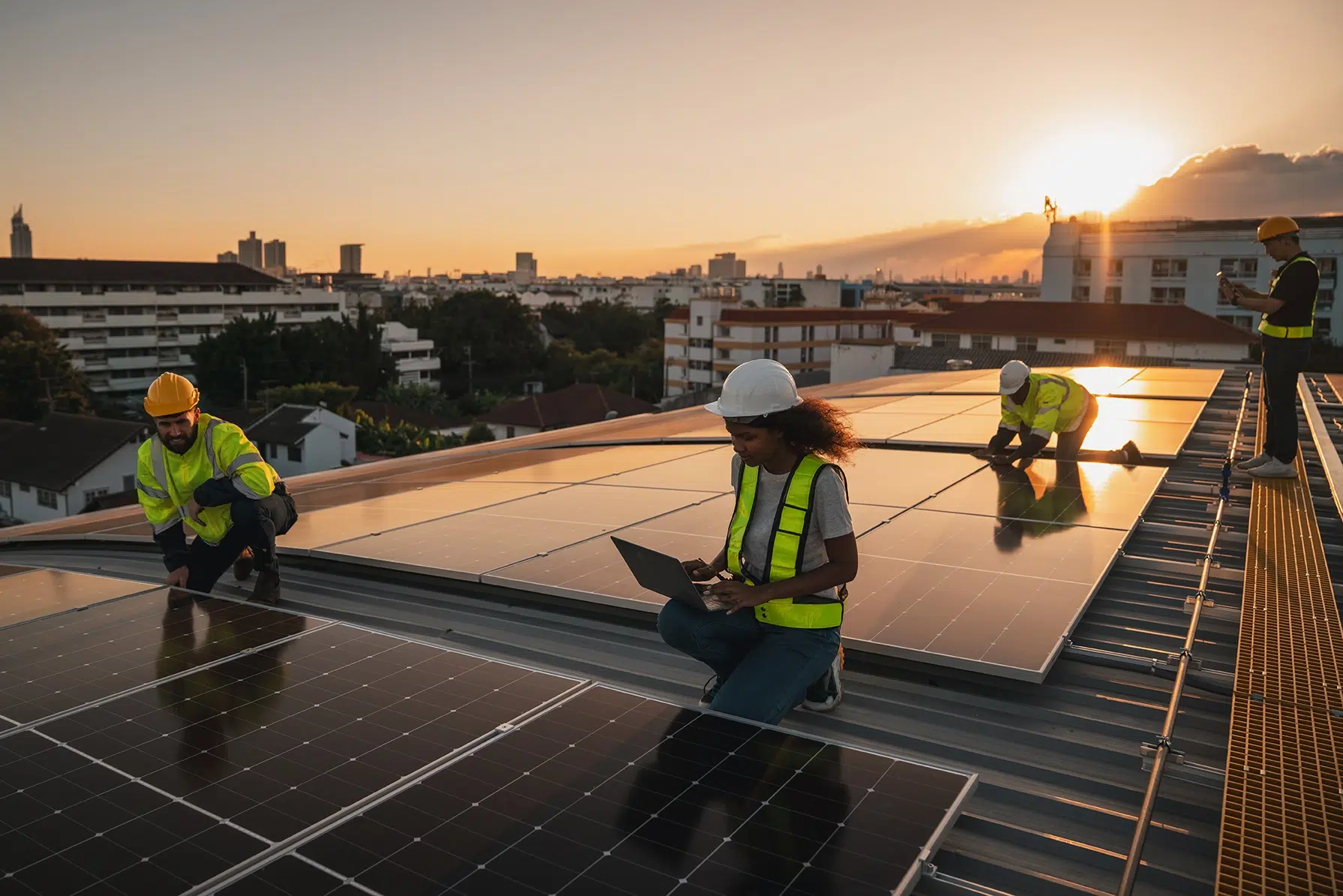
Installing solar panels on the roofs of your industrial buildings gives you the opportunity to reduce your energy bills. In recent years, Europe has seen a significant increase in energy prices:
Post-COVID-19 economic and industrial recovery
Energy demand has risen sharply with the economic recovery.
Conflict in Ukraine
Much of Europe's electricity depends on natural gas. The increase in gas prices, amplified by the decline in Russian imports, has a direct impact on the cost of electricity. In France, where the electricity market is linked to gas, this situation has led to an increase in tariffs.
Faced with these tensions in the energy market, action must be taken to control your energy costs. At AR SERVICES, we support you in implementing sustainable energy solutions tailored to your needs. Thanks to these solutions, you can not only limit the impact of energy price increases, but also strengthen your autonomy and energy transition.
The stages of your energy transition
Customized study
One of our experts will visit your industrial site to understand your needs. We will carry out a technical and feasibility study of your project, calculate the projected photovoltaic yield, and offer you the solution best suited to your needs.
Administrative procedures
We take care of all the administrative procedures to ensure the project runs smoothly and to make the process as seamless as possible for you.
Installation and commissioning
We will visit your farm to install your solar panels.
Servicing and maintenance
AR SERVICES is responsible for the upkeep, maintenance, and repair of the facilities.
Why install solar panels for your industry?
Comply with the law
Save money
Generate additional income
Reducing your carbon footprint
Achieving decarbonization goals
Choose the solution that best suits your needs
Total sales
Sell all of your electricity production to EDF at the regulated purchase price and enjoy a stable and sustainable additional income.
Self-consumption with sale of surplus
Use the energy you generate directly on your site and sell any surplus electricity to EDF at the current feed-in tariff.
Self-consumption with storage
Consume your own electricity and store the surplus in a battery to use when you need it.
The different photovoltaic installations
Photovoltaic roofs
suitable for existing buildings, whether they have flat or sloped roofs.
Photovoltaic shade structures
Installed in parking lots, they generate electricity while providing shade for vehicles.
Ground-mounted solar power plants
Ideal for the available land, they enable large-scale energy production.

Everything you need to know about photovoltaics in the industrial and service sectors
What are the legal requirements for installing photovoltaic panels in the industrial sector?
The Climate and Resilience Act requires industrial and commercial buildings larger than 500 m² to incorporate renewable energy production systems, such as photovoltaic panels, covering at least 30% of the roof, with a target of 50% by 2030. This requirement aims to accelerate the energy transition and make the most of available space. It is essential to comply with these regulations to avoid penalties and benefit from the financial assistance available.
What financial assistance is available for businesses?
Several schemes provide financial support for companies' photovoltaic projects. This support varies depending on the size of the installation, its location, and the type of building.
| Device | Eligibility requirements | Amount / Rate | Terms and conditions |
| Self-consumption bonus | - Roof installation - Power ≤ 100 kWp - Self-consumption with sale of surplus | - ≤ 3 kWp: €80/kWp - ≤ 9 kWp: €80/kWp - ≤ 36 kWp: €160/kWp - ≤ 100 kWp: €90/kWp - > 100 kWp: not eligible for the subsidy | - Payment by EDF OA or other obligated purchaser - In one go if ≤ 9 kWp - Otherwise, 80% in the first year, then 5% per year for four years. |
| Photovoltaic purchase obligation | - Total sale or self-consumption with sale of surplus - RGE-certified installer | Surplus purchase price: - ≤ 3 kWp: €0.1301/kWh - ≤ 9 kWp: €0.1301/kWh - ≤ 36 kWp: €0.0781/kWh - ≤ 100 kWp: €0.0781/kWh Total purchase price: - ≤ 3 kWp: €0.1430/kWh - ≤ 9 kWp: €0.1215/kWh - ≤ 36 kWp: €0.1355/kWh - ≤ 100 kWp: €0.1355/kWh | - Sales contract with EDF OA or other obligated purchaser - Duration: 20 years - Rates revised quarterly |
| Tax benefits | - Businesses subject to VAT - Roof or shade structure installation | - Recovery of 20% VAT on the purchase and installation of photovoltaic panels | - Need for a self-consumption contract with sale of surplus - Installation of more than 3 kWp |
| 50% reduction in IFER | - Photovoltaic panels with a power rating > 100 kWp | - Reduced rate of €3.394 per kilowatt-peak of installed electrical power, compared to the usual rate of €6.788 |
How do I size a photovoltaic system for my business?
The dimensions depend on several factors:
- Energy consumption: estimate annual consumption in kWh.
- Available surface area: calculate the usable roof or land area.
- Financial objectives: determine the desired return on investment.
To get an idea, visit our online simulator and discover what might suit you in just a few clicks.
What is the cost of installing photovoltaic panels on buildings?
The cost of a photovoltaic installation on industrial buildings varies according to several criteria:
- The building's layout
- The proximity of a connection point to the electrical grid
- The power of the installation
- Roof accessibility during installation
- The quality of the equipment
- Related services